
Lewy, This Is Todd, Todd Meet Lewy
When It Looks Like a Stroke… But Isn’t: Understanding LBD and Todd’s Paresis
There are moments in caregiving that stop you cold; where your heart drops before your brain can catch up.
For those of us walking alongside someone with Lewy Body Dementia (LBD), we get used to the unexpected. The fluctuations. The “good” days that turn on a dime. The episodes that leave us questioning everything we thought we understood.
And then… something happens that looks different.
More intense. More alarming.
What would “normally” (ha! what is normal exactly?) be choking on some milk and re-righting yourself becomes a blue face, gasps of air, and slumping on the table …
Something that looks like a stroke.
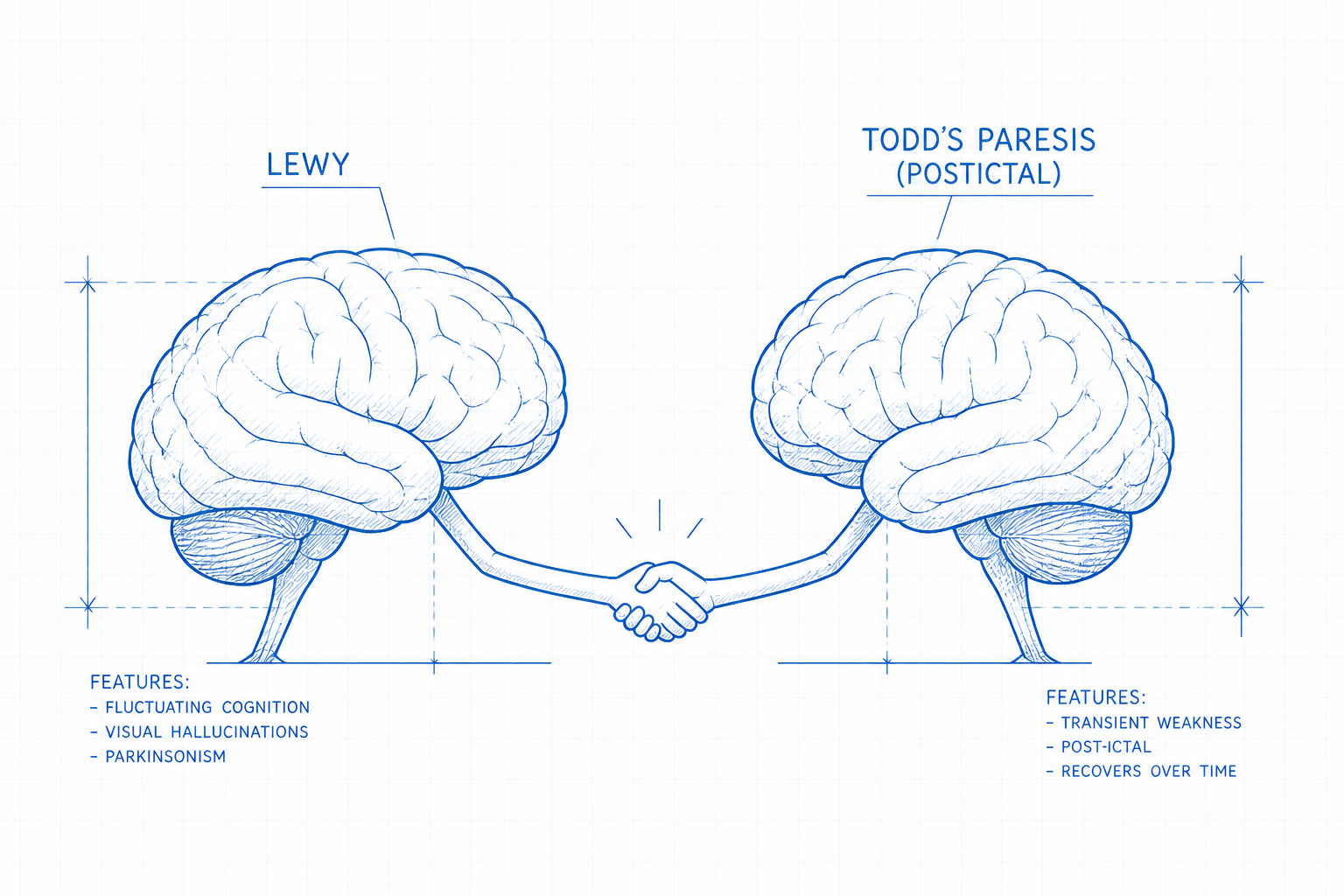
Lewy brought along a new friend this last week, Todd. Never heard of him, never saw him either, but boy did he plop himself right into the middle of our life.
First, Let’s Talk About Our Buddy, Lewy (Lewy Body Dementia)
LBD is already a master of disguise.
It blends cognitive decline with physical symptoms, often mimicking both Alzheimer’s and Parkinson’s. One day might bring confusion and hallucinations, the next might bring stiffness, shuffling, or slowed movement.
It’s unpredictable by nature.
And because of that unpredictability, when something new shows up—something more dramatic—it can feel impossible to know what’s really happening.
Enter: Todd’s Paresis
Todd’s Paresis (also called Todd’s Paralysis) is something many caregivers have never even heard of… until they see it.
It typically happens after a seizure.
And here’s the part that rattles you:
Sudden weakness or paralysis (often on one side of the body)
Slurred or limited speech
Confusion or unresponsiveness
Extreme fatigue
Eyes fixed or abnormal movements
Sound familiar?
It should.
Because it can look almost identical to a stroke.
So… What’s the Difference?
Here’s where things get tricky - and why this matters so much in real life.
A stroke is caused by a disruption of blood flow to the brain. It’s a medical emergency that requires immediate intervention.
Todd’s Paresis, on the other hand, is a temporary neurological condition following a seizure. It can last minutes…
or even hours…
sometimes up to a day or two.
But in the moment?
You cannot tell the difference just by looking.
Let me say that again, because it matters:
You cannot safely assume it’s Todd’s Paresis.
It must be treated like a stroke until proven otherwise.
Where LBD Complicates Things
Here’s where the overlap becomes even more challenging.
Individuals with LBD can experience:
Episodes of unresponsiveness
Sudden changes in awareness
Movement abnormalities
Increased risk of seizures (in some cases)
So when Todd’s Paresis enters the picture, it doesn’t feel like something completely separate.
It blends right into the already complicated landscape of LBD.
And for caregivers?
That means more second-guessing.
More “Is this different or just another variation?”
More moments of panic layered with uncertainty.
Here’s the key piece most people don’t realize
Todd’s Paresis doesn’t occur on its own.
It only happens after a seizure.
So when you’re asking:
“Will it happen again?”
What you’re really asking is:
→ “Will there be more seizures?”
If seizures continue, Todd’s Paresis can repeat
Some people experience it only once after a single seizure
Others may have it after multiple seizures, especially if seizures are recurring or not well controlled
The severity and duration can vary each time (minutes → hours → occasionally longer)
There’s no clean pattern like:
“Once you have it, you’ll always have it.”
But there is a connection:
More seizures = higher chance of more episodes of Todd’s Paresis
Where this gets tricky with LBD
With Lewy Body Dementia, things are already messy.
Because LBD can include:
Fluctuating awareness
Episodes that look like seizures (but aren’t always)
Sudden changes in responsiveness
So when Todd’s Paresis shows up, it can:
Blend in with LBD symptoms
Be misinterpreted as progression
Or even make it harder to recognize that seizures are happening at all
A really important distinction
If you’re seeing repeat “episodes” that look like Todd’s Paresis, it’s worth asking:
Are these actually recurrent seizures followed by weakness?
Or are they LBD-related fluctuations that look similar?
That’s a conversation for neurology—but it’s an important one.
The Emotional Reality (Let’s Be Honest Here)
These episodes don’t just affect the person experiencing them.
They hit us - and hit us hard.
You’re watching someone you love:
Lose control of their body
Drift out of awareness
Become unresponsive in ways you’ve never seen before
Your mind is racing:
“Is this a stroke?”
“Is this it?”
“Am I about to lose them?”
And even when the episode passes…
You don’t just bounce back.
You sit with it.
You replay it.
You carry it.
What Caregivers Need to Know
This isn’t about turning you into a medical professional.
It’s about giving you just enough understanding to navigate these moments with a little more clarity - and a little less fear.
Always treat sudden neurological symptoms as an emergency first
Document what you see (time, symptoms, duration)
Share patterns with healthcare providers
Ask about seizure activity if episodes are recurring
Because sometimes what looks like one thing… is actually another.
Frazzled Truth
No one hands you a manual for moments like these.
No one prepares you for the way your adrenaline spikes…
or how your hands shake…
or how quiet the room feels afterward.
LBD keeps us on our toes.
Todd’s Paresis adds another layer we didn’t ask for.
But knowledge?
Even just a little?
It gives us something to hold onto when everything else feels like it’s slipping.