
The Power Of The Dry Erase Pen
It’s funny the things you don’t think about until you’re in it.
Hospital stays have a way of turning even the most organized, on-top-of-it person into someone just trying to keep up with the moment. There’s a rhythm to it—but it’s not your rhythm. It’s alarms, vitals, shift changes, and trying to remember what day it is.
And then there’s the board.
You know the one.
That big dry erase board on the wall with all the little boxes—
Patient name.
Nurse name.
Date.
Goals.
Notes.
It’s meant to help.
But more often than not… it’s half empty.
Our Last Visit…
We were lucky—very lucky—to have the nurse’s name filled in.
But the rest?
Blank.
No date.
No day of the week.
No contact information.
No notes.
And in that moment, standing there, trying to orient ourselves in a space that already felt overwhelming, it hit me:
We needed to take this board back.
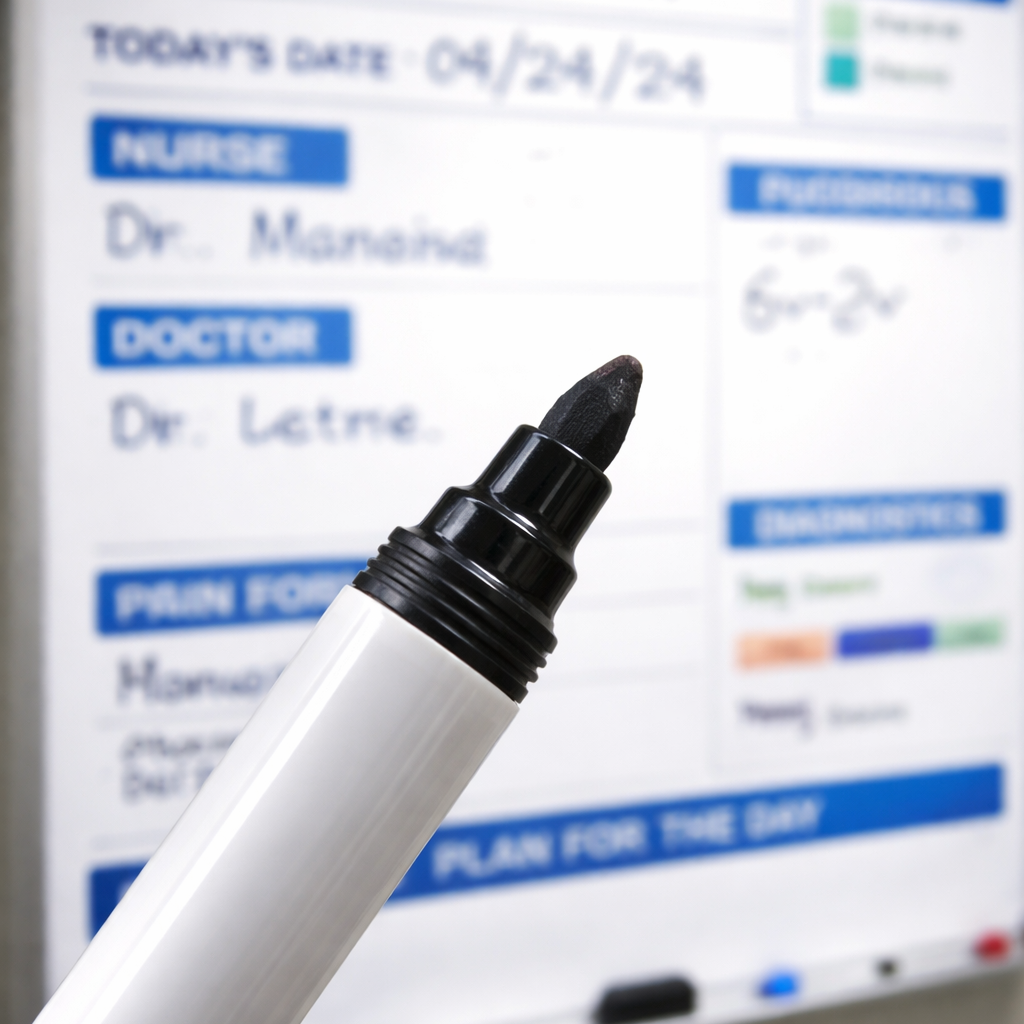
Enter: The Dry Erase Pen
Simple. Small. Easy to tuck into your bag.
But powerful.
Because when so much feels out of your control … this is one thing you can take ownership of.
Why It Matters More Than You Think
Grounding in Time (Because Days Blur Together)
Patients often struggle with knowing what day it is.
Closed blinds. Artificial lighting. Interrupted sleep.
Day and night start to feel the same.
Writing the day and date on that board becomes more than information - it becomes an anchor.
“Today is Tuesday.”
“It’s morning.”
Simple. But stabilizing.
Your People - Right There, No Guesswork
In an emergency, seconds matter.
Can you imagine someone flipping through a chart, searching for the right contact number?
Instead, we wrote:
Primary contact name - That’s me!
Phone number - I put two
Secondary contact (just in case) - My daughter, the RN!
Clear. Visible. Immediate.
No digging. No delays.
Critical Details That Can’t Be Missed
Charts are thorough—but they’re not always visible.
And when multiple staff members rotate in and out, those quick visual cues matter.
We added notes like:
“Visual impairment – left eye”, uses cane
“Hearing challenged - left ear”
“Fall risk”
Because yes… even something as simple as a red fall-risk bracelet can be removed and not replaced.
And when that happens, it’s the little reminders that help keep someone safe.
Don’t Overlook the “Other” Box
That big square labeled “Other:”? Probably located in the lower right corner? That’s generally empty?
That’s it …
It’s one of the most important spaces on the board.
This is where you can write specific, personal, non-negotiable information that may not be immediately obvious in a chart.
For me, that looked like:
“Do not modify medications without first speaking to spouse (contact information above).”
Schedule of medications AM dosage and PM dosage are in the medical record. (I’ve since taped a detailed list to the board when we’re admitted.)
Clear. Direct. Visible to everyone walking into the room.
Because when you’re not there—or even when you are—this note speaks for you.
A Small Sense of Control in a Big, Uncertain Space
Let’s be honest - hospital stays can feel like everything is happening to you.
This is one small way to shift that.
To participate.
To advocate.
To support.
To say:
“We’re here. We’re paying attention. And we’re part of this care.”
Frazzled Truth
Sometimes the most powerful tools aren’t the big, complicated ones.
Sometimes…
It’s as simple as a dry erase pen. I use different colors so that the board is “seen”!
A Gentle Takeaway
If you or someone you love is heading into a hospital stay, toss one (a pen or a pack of pens) into your bag.
Not because it solves everything.
But because in a space that can feel overwhelming…
it gives you one small, meaningful way to stay connected, informed, and in control.